Posts

How is Rice Drip Irrigation Beneficial?

  India is one of the largest producers and consumers of rice. But much of India’s agricultural land under rice cultivation grows rice conventionally. With conventional irrigation, cultivating one kilogram of rice requires up to 5,000 liters of water.Thus, imagine the amount of water the crop consumes at the national scale! But rice drip irrigation can turn things around. Let’s see how. 4 Benefits of Rice Drip Irrigation Let’s look at some enticing benefits associated with rice drip irrigation . 1.     Substantial Water Savings Drip irrigation involves the use of water precisely in the quantities required. It avoids the wastage of water. So, while conventionally, rice requires up to 5,000 liters of water, drip irrigation brings it down to about 1500-1600 liters per kilogram of yield. It refers to almost 60-65 percent of water savings! 2.     Enhanced Marketable Crop Quality Paddy farming keeps rice roots submerged, consuming heavy metals an...
Drip Irrigation Maintenance

Image
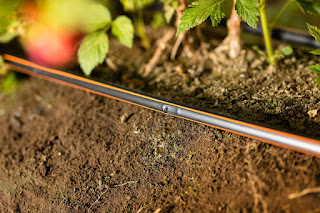
  Before beginning of the irrigation season, the system is to be prepared for the new season. Many temporary repairs made last year will probably need attention. Drip irrigation maintenance is important to grow high quality of crops. Following things are necessary for preseason tune up. The pump should be tested for its performance Check the filters for their operations. Check the system for leaks. Control working pressure at the end point. Control system flow (flow meter). Control pressure differential over the filters. Flush fertilizer system with water. Proper selection of system, designing, installation, operation & maintenance results in high returns, longer Life, total satisfaction. Grow high quality crops using drip irrigation with  Netafim .  

FLEXNET™- The industry's only leak-proof flexible pipe

  An interview with Mr. Chandrakant Ramani about Netafim’s FLEXNET™ pipes -   portable, leak-free main and submain pipes. It weighs less than half as much as other pipes, you can order it with customized pre-welded outlet spacing for your land, it is four times faster to install and it never leaks.

Everything You Need To Know About Drip Irrigation Systems

Drip irrigation is the most efficient water and nutrient delivery system for growing crops. It delivers water and nutrients directly to the plant’s roots zone, in the right amounts, at the right time, so each plant gets exactly what it needs, when it needs it, to grow optimally. Thanks to drip irrigation, farmers can produce higher yields while saving on water as well as fertilizers, energy and even crop protection products. How does it work? Water and nutrients are delivered across the field in pipes called ‘dripper lines featuring smaller units known as ‘drippers’. Each dripper emits drops containing water and fertilizers, resulting in the uniform application of water and nutrients direct to each plant's root zone, across an entire field. There are multiple benefits of drip irrigation some of are as follows Benefits of Drip Irrigation: Better plant health Reduced risk of disease Adaptability Saves time Requires less work and maintenance Prevents disease Reduces weed growth Drip...

The Future of Farming: Smart Community Irrigation Solutions

  The world has been living in the ignorant belief for centuries that “We’ll always have enough water for ourselves” Water is essential for life.  However, the unthinkable has unfortunately happened, and right now 43 countries, which comprise about 700 million people across the globe, are facing worrying levels of water crisis. The United Nations further estimates that as early as 2025, two-thirds of the population of the world will be suffering in water-stressed regions. Another issue that’s hitting the world at an alarming rate is the world population growth. Increasing population is directly proportional to surging food demand, traditional agricultural itself consumes nearly 70% of the water available globally. Studies show that 2050 will witness a 50% increase in the demand of water for agriculture. The global water scene looks quite appalling. Are the depleting natural resources the only problem? No, not really. While resources are indeed a limitation, it’s usage patterns also...

How precision irrigation helps sugarcane cultivation?

Sugarcane is one of the extensively cultivated crops in India. Sugarcane farmers are always in the pursuit of higher crop yields, increased profitability, higher sucrose content, and an extended ratoon life, and reduced operational costs. Drip irrigation works as a solution here, which is why sugarcane farmers have been upgrading their farms to drip irrigation. Sugarcane cultivation yield has a strong reaction towards temperature, solar radiation and soil conditions. However, in an open farm field, temperature and radiation are beyond human control. Here, drip irrigation plays an instrumental role as it controls every drop of water and nutrient going to the crop, and that too at the right time, to result in a higher amount and quality of yield, along with higher sucrose content and extended plant life. Netafim’s Subsurface Drip Irrigation helps grow sugarcane yield through the supply of nutrients and water directly to the crop root, and in the required quantities and when required. S...

How to Apply for a Drip Irrigation Subsidy in Maharashtra?

Image
  Adopting drip irrigation techniques is an advantageous decision as it helps you grow more in less, andaugments your faming income. However, since drip irrigation demands a significant investment, the Indian government offers a drip irrigation subsidy in every state. In Maharashtra, farmers with land holding of more than 2 hectares get 45% subsidy, and those with less than 2 hectares are entitled to get 55%. So, if you are a farmer who wants to apply or a drip irrigation subsidy in Maharashtra, this blog helps you with the process for it. The Process to Apply for a Drip Irrigation Subsidy in Maharashtra Let us now look at the steps to apply for drip irrigation subsidy in Maharashtra. Internal Communication Note: Please paste step by step screen shots of the process from the PDF shared. Visit https://mahadbtmahait.gov.in/ (Image No 4 in the PDF) Click on the Farmer Schemes tab at the right side. (Image No 6 in the PDF) Click on the New Applicant Registration Tab to register you...